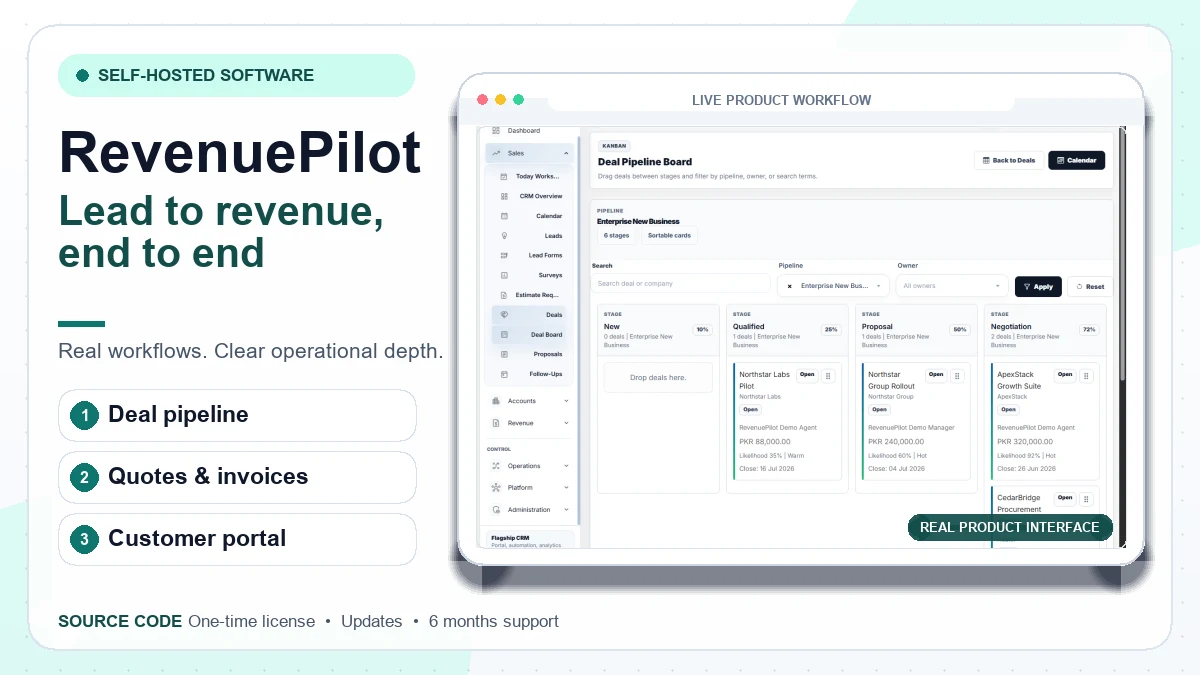
A RevenuePilot buyer guide for reviewing leads, deals, quotations, invoices, payments, client portal, support, reports, permissions, and launch readiness.
A Real Moment
A company receives inquiries from forms, calls, referrals, and campaigns, but sales, quotations, invoices, support, and reports live in different places. The buyer needs to know whether RevenuePilot can keep the whole commercial journey visible without turning the team back to spreadsheets.
The useful question is simple: Can the buyer prove one complete journey from lead intake to deal, quotation, invoice, payment, delivery, support, client portal, and readiness note?
That is why this note starts with the work, not with software vocabulary. For business owners, sales teams, account managers, support teams, demo operators, and operations staff reviewing a full lead-to-revenue CRM before launch, a lead to revenue CRM launch workflow only matters when it helps a person finish a job with less guessing. In plain terms: leads, deals, quotations, invoices, payments, delivery, support, client rooms, reports, permissions, and system health should feel like one connected revenue operation.
The Human Problem
CRM buying gets risky when a demo only shows a pipeline board. Revenue teams need to see how sales records become real quotations, invoices, payments, delivery tasks, support tickets, and customer-facing portal history before real customer data enters the system.
Most bad launches do not fail because nobody knew the fancy words. They fail because nobody wrote down what was supposed to happen for the buyer, manager, agent, or admin. Then every small mistake becomes a meeting: who owns this, where is the proof, why did the email not arrive, why is the account different from the order?
For Ovion Market, the rule is practical. A product, demo, guide, or service should be easy to explain to a non-technical owner, easy to test with a normal account, and easy to support after the first launch.
Walk It Like A Buyer
Start on the dashboard, create or inspect a lead, turn it into a company/contact/deal, move the deal through the pipeline, review quotation and invoice context, inspect payments and receivables, then open delivery, support, portal, reporting, permissions, and system health.
RevenuePilot
RevenuePilot is a good fit when the required workflow, platform, and support expectations match your launch plan.
- Product metadata includes platform, version, support, and compatibility context.
- Demo and docs links are shown when available.
- Screenshots and changelog help validate buyer expectations.

Command dashboard
Executive CRM dashboard with leads, active deals, expected revenue, receivables, follow-ups, and forecast trend.
- Command dashboardExecutive CRM dashboard with leads, active deals, expected revenue, receivables, follow-ups, and forecast trend.
RevenuePilot buyer checks
- Confirm Laravel hostingPHP 8.2+, database, writable storage/bootstrap cache, queue/scheduler, and mail should be available.
- Review CRM workflow fitCheck whether leads, deals, quotations, invoices, payments, support, and portal boundaries match the business model.
- Open live docsUse the CRM docs page for installation, demo, setup, and production-readiness details.
- Plan permissionsMap owner, sales, support, demo operator, admin, and client access before importing real data.
- Hosting cannot meet the requirementsPause if your PHP, database, queue, mail, storage, or extension setup cannot match the documented requirements.
- You need done-for-you setup without a setup requestRequest installation help before checkout when your team cannot handle hosting, environment, import, or handoff work.
Turn this guide into a buyer proof run
Choose RevenuePilot, inspect one product screen, confirm before-buy checks, and save the result as a proof report.
- Confirm Laravel hosting
- Review CRM workflow fit
- Open live docs
Keep a record of what you inspected
Generate a shareable evaluation report after opening roles, screenshots, docs, compatibility notes, and setup checks for RevenuePilot.
Open demo roomStart with the main user action. Ask who uses it, what they enter, what they expect to see next, and what confirmation they receive. Then test the quiet parts that usually create support pain: emails, permissions, payment states, mobile layout, failed attempts, and support notes.
Translate every technical item into a normal sentence before you move on. A webhook means "the payment company tells your store what happened." A license activation means "this domain is allowed to use the purchase." A visual builder revision means "you can restore the older page if the new edit is wrong."
Decision Flow
Use the flow as a short working map. Start with what happened, name the owner, inspect the screen, collect proof, and choose the next human action before the topic turns into an open-ended technical task.
Checks Worth Doing First
- Open the live RevenuePilot demo and confirm the role-safe demo operator account.
- Review leads, companies, contacts, deals, follow-ups, notes, saved views, imports, and exports.
- Follow the revenue handoff from quotation to contract, invoice, payment, receivables, and forecast.
- Inspect delivery, projects, tasks, support tickets, customer rooms, and portal boundaries.
- Check docs, screenshots, launch readiness, system health, and permission planning before checkout.
These checks are intentionally small. They help you spot the difference between a nice demo and a product that is ready for your own store, service site, SaaS account, or team workspace.
Keep the dashboard, lead list, deal board, quotation or invoice screen, payment/receivable state, task board, support inbox, client portal, and system health check together as the revenue proof pack.
How It Maps To Ovion Market
Ovion Market connects RevenuePilot with the product page, live demo room, canonical documentation, role-safe demo account, CRM screenshots, before-buy checks, and launch readiness proof. The guide keeps the buying path honest about hosting, queues, mail, permissions, portal exposure, and public credential boundaries.
The related Ovion Market context is RevenuePilot. That does not make this a sales page. It means the note is tied to real marketplace behavior: products need requirements, demos, downloads, licenses, checkout states, support paths, and clear public pages.
Mistakes I Would Watch For
- Judging RevenuePilot from the dashboard without following a lead into quotation, invoice, payment, and support.
- Publishing admin or super-admin credentials instead of the limited public demo operator account.
- Skipping queue, scheduler, mail, storage, and backup checks before production launch.
- Treating the client portal as a separate app instead of part of the same customer revenue history.
Most launch problems come from skipped basics, not from advanced code. Confirm the product fit, test the everyday path, write down support expectations, and avoid sending paid traffic to a page or checkout that has not been checked.
Final Note For The Handoff
Before you move from planning to launch, write down the owner, the expected result, the test account used, and the page or screen where the result was checked. That small record helps buyers, developers, support staff, and marketers stay aligned. It also makes future updates easier because the team can compare the new behavior against a clear baseline instead of relying on memory.
Helpful Internal Links
- RevenuePilot product page
- RevenuePilot live demo room
- RevenuePilot documentation
- RevenuePilot launch readiness
- CRM products
Source Notes
- Laravel documentation: https://laravel.com/docs
- OWASP web security guidance: https://owasp.org/www-project-top-ten/
- RevenuePilot product page: /products/revenuepilot-crm
- RevenuePilot documentation: https://docs.ovion-tech.xyz/apps/crm/index.html
